
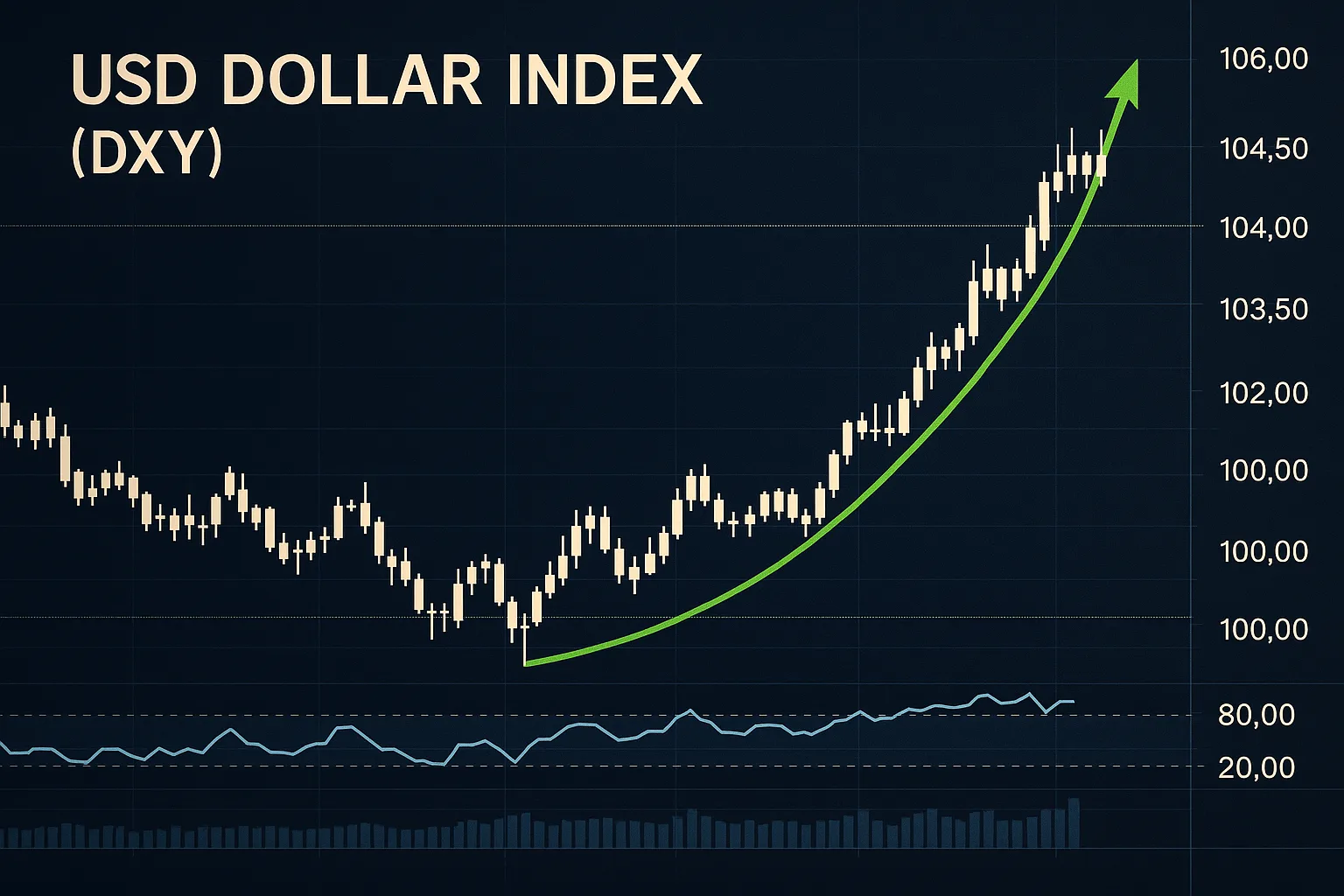
USD Is Surging Again. Here's How to Trade It
DXY just broke 106.50 as rate-cut bets collapse. EURUSD, GBPUSD, and USDJPY are all in play. Here's a practical strategy for the current environment.
Exness offers 0.0-pip spreads on EURUSD and USDJPY during peak sessions. Commission-free options available for standard accounts.
Open Exness Account →The DXY Rally Explained
The US Dollar Index (DXY) measures the value of the US dollar against a basket of six major currencies: the euro (EUR, 57.6% weight), Japanese yen (JPY, 13.6%), British pound (GBP, 11.9%), Canadian dollar (CAD, 9.1%), Swedish krona (SEK, 4.2%), and Swiss franc (CHF, 3.6%). When DXY rises, USD is strengthening across the board.
After the Fed's March 18 hawkish hold decision, DXY surged from 104.20 to 106.80 over three sessions. a move of approximately 2.5%. In currency markets, that's significant. The driver is simple: when the Fed signals it will keep rates at 3.50–3.75% for longer, US Treasuries become more attractive relative to European, British, and Japanese bonds. Capital flows from those markets into US assets, buying USD in the process.
The ECB cut rates to 2.25% in February 2026. The Bank of England held at 4.25% but has signaled cuts coming in Q2. The Bank of Japan sits at 0.75%. In this environment, the interest rate differential firmly favors USD. and that divergence can persist for months.
Which Pairs to Trade
Short EURUSD. Primary Trade
EURUSD is the highest-liquidity forex pair and the cleanest expression of USD strength. The ECB's rate cuts create a widening differential vs. the Fed's hold. EURUSD has broken below 1.0850 support. the next key level is 1.0680, which aligns with the 200-week moving average and the September 2025 low.
Entry: Sell EURUSD on rallies toward 1.0870–1.0900 (resistance zone)
Target: 1.0680 (primary), 1.0580 (extended)
Stop loss: 1.0960 (above recent consolidation high)
Risk/Reward: Approximately 1:2.5
Short GBPUSD. Secondary Trade
The British pound is additionally pressured by soft UK economic data. GDP growth is tracking at 0.2% for Q1 2026, and the BoE has signaled a May cut is possible. GBPUSD broke 1.2600 support and is heading toward 1.2400.
Entry: Sell GBPUSD on pullbacks to 1.2620–1.2650
Target: 1.2400 (primary)
Stop loss: 1.2720
Risk/Reward: Approximately 1:2.0
Long USDJPY. Carry Trade
USDJPY is the classic carry trade: borrow cheap yen, buy high-yielding USD. With a 270+ basis point differential still in play, the carry is positive and the trend is supportive. USDJPY has cleared 151.00 and is approaching the psychological 152.00 level where BoJ intervention risk increases.
Entry: Buy USDJPY on dips to 150.50–151.00
Target: 153.50 (primary), with caution above 152.00 for intervention risk
Stop loss: 149.80
Risk/Reward: Approximately 1:2.0 to first target
Long USDCHF. Safe Haven Unwind
As risk-off sentiment fades post-Fed and USD dominates, USDCHF can trend higher. The Swiss National Bank has been active in weakening CHF, and a softer Swiss inflation print recently gives them room to cut. USDCHF has resistance at 0.9050. a break confirms the bullish trend.
Risk Management Rules
USD strength trends can last weeks or months, but they also feature violent counter-trend moves. To survive and profit in this environment, strict risk management is non-negotiable.
- 1–2% per trade maximum: Never risk more than 2% of your account on any single position. For a $5,000 account, that's $50–$100 max loss per trade.
- No more than 3 correlated positions simultaneously: EURUSD short, GBPUSD short, and USDJPY long are all USD-strength bets. If USD reverses sharply, all three move against you simultaneously.
- Use stop-losses, always: No exceptions. Set your stop-loss the moment you enter the trade, not after.
- Scale in, don't average down: If EURUSD moves against you and you add to a losing position, you've doubled your risk without improving your entry logic.
- Review after NFP and CPI: These two data releases can invalidate the entire trade thesis. Reduce exposure before major data events unless you're specifically trading the news.
Broker Recommendations for USD Pairs
For high-frequency USD pair trading, spread and execution quality are everything. Our top choices:
- Exness: 0.0–0.2 pip EURUSD raw spread, $10 minimum, instant withdrawals. Best for smaller accounts.
- IC Markets: Consistently sub-0.1 pip EURUSD ECN spread. Best for scalpers.
- Pepperstone: TradingView integration with ECN execution. Best for chart-based traders.
Recommended Brokers
All brokers independently reviewed and tested by our team.
Ready to Trade the USD Rally?
Exness: tight spreads on all major USD pairs, leverage up to 1:2000, instant withdrawals.
Open Exness Account →