
What Is a Forex Spread? The Real Cost of Trading Explained
The spread is the #1 hidden cost in forex trading. Most beginners don't understand what it costs them until it's too late. Here's everything you need to know.
Exness offers EURUSD from 0.0 pips on Raw accounts. Minimize your trading costs from day one.
Open Exness Account →The Bid and Ask Price
Every currency pair in forex has two prices: the bid and the ask (also called the offer). The bid is the price at which the market (your broker or liquidity provider) will buy the base currency from you. this is the price you sell at. The ask is the price at which the market will sell the base currency to you. this is the price you buy at.
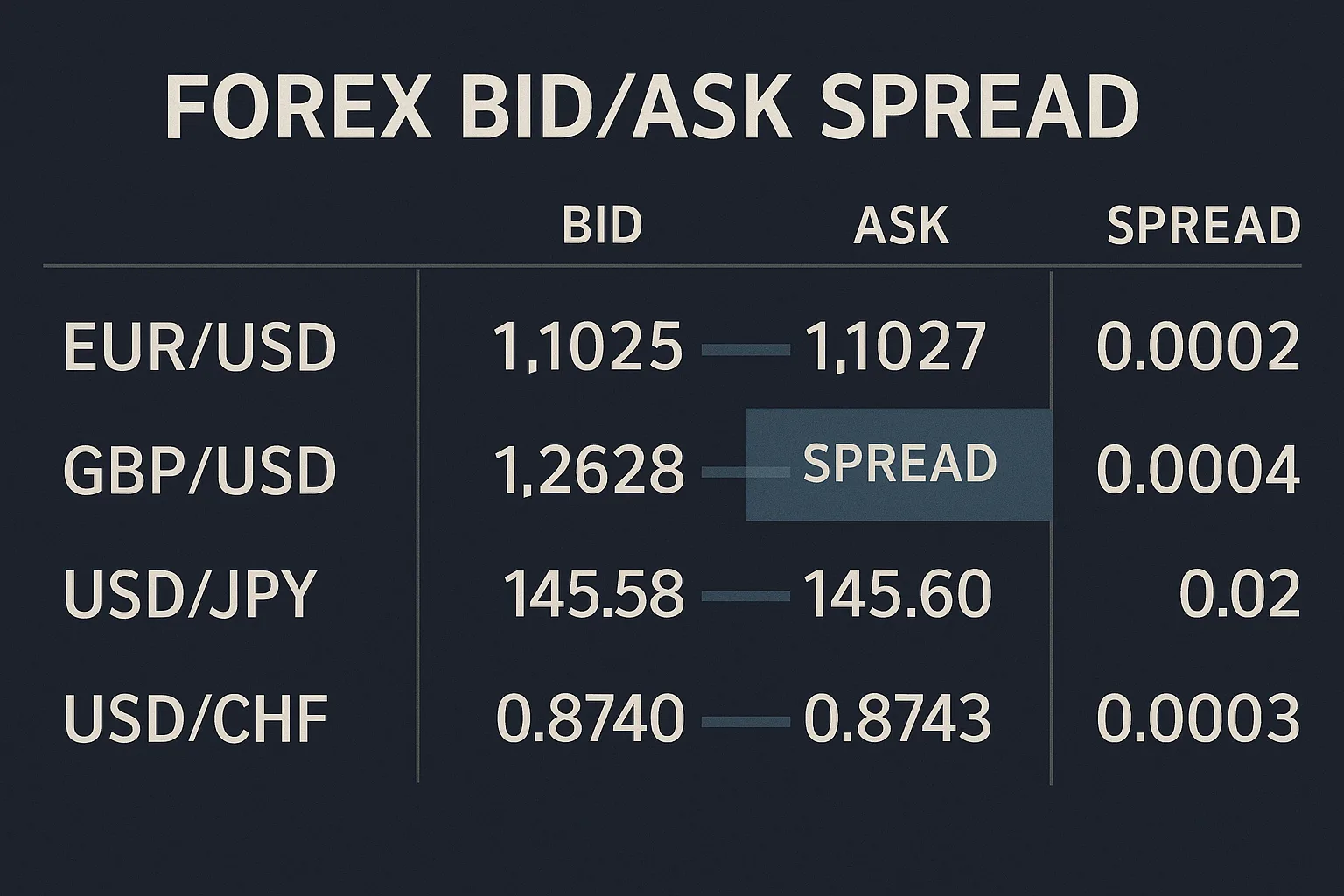
The spread is simply the difference between these two prices. If EURUSD has a bid of 1.08500 and an ask of 1.08508, the spread is 0.00008. or 0.8 pips.
What Is a Pip?
A pip (percentage in point) is the standard unit of measurement for price movement in forex. For most currency pairs, 1 pip = 0.0001 (the fourth decimal place). So if EURUSD moves from 1.0850 to 1.0851, it has moved 1 pip.
For JPY pairs (USDJPY, EURJPY), 1 pip = 0.01 (the second decimal place), because yen pairs trade at a different scale.
How to Calculate Spread Cost in Real Money
The cost of the spread depends on three factors: the spread in pips, your lot size, and the pip value for the currency pair.
Formula: Spread Cost = Spread (pips) × Pip Value × Lot Size
For EURUSD, the pip value for 1 standard lot (100,000 units) is approximately $10.
Per round-turn trade (entry + exit). For mini lots, divide by 10. For micro lots, divide by 100.
Fixed vs. Variable Spreads
Fixed spreads stay constant regardless of market conditions. Whether it's quiet at 3am or volatile during NFP, you always pay the same spread. Fixed spreads are typically higher than variable ECN spreads during normal hours, but they eliminate surprise costs during news events.
Variable spreads fluctuate based on market liquidity. During peak London/New York session overlap (1pm–4pm UTC), EURUSD spreads on ECN accounts can be 0.0–0.2 pips. During Asian session or around major news, the same account might see 0.5–2.0 pips.
For most active traders, variable ECN spreads are cheaper on average. but you need to be aware of spread widening during high-impact news.
ECN vs. Market Maker: What It Means for Your Spread
Market makers act as the counterparty to your trades. They set their own bid/ask prices, pocket the spread, and may or may not hedge their exposure in the interbank market. This creates a conflict of interest: when you profit, the broker loses (and vice versa). Market makers typically offer fixed or near-fixed spreads and no external commission.
ECN (Electronic Communication Network) brokers connect your orders directly to a network of liquidity providers. banks, hedge funds, and other market participants. They make money through commission rather than spread markup. ECN spreads are tighter but you pay a separate commission per trade.
For active traders making 50+ trades per month, ECN is almost always cheaper. See our ranking of the best ECN brokers for raw spreads to find the tightest pricing. For casual traders making 5–10 trades per month, the distinction matters less.
Typical Spreads by Currency Pair (2026)
| Pair | ECN Average | Market Maker Avg |
|---|---|---|
| EURUSD | 0.0–0.2 pips | 0.6–1.2 pips |
| GBPUSD | 0.1–0.4 pips | 0.8–1.8 pips |
| USDJPY | 0.1–0.3 pips | 0.7–1.5 pips |
| USDCHF | 0.2–0.5 pips | 1.0–2.0 pips |
| AUDUSD | 0.1–0.4 pips | 0.8–1.6 pips |
| XAUUSD | 0.05–0.20 pips | 0.25–0.50 pips |
| BTCUSD | 5–20 pips | 20–60 pips |
How to Minimize Spread Costs
- Choose an ECN broker: For active traders, ECN + commission is cheaper than high-spread market makers. Compare the lowest commission forex brokers to find the best deal.
- Trade during peak hours: London/New York overlap (1pm–4pm UTC) has the tightest spreads for EUR, GBP, and USD pairs.
- Avoid trading during news releases: Spreads widen dramatically during NFP, CPI, and Fed announcements. Either avoid or use limit orders.
- Trade major pairs: EURUSD, GBPUSD, USDJPY, and USDCHF have significantly tighter spreads than exotic pairs like USDZAR or USDTRY.
- Compare brokers: Spread differences between brokers are significant. A 0.3-pip difference on EURUSD costs $3 per standard lot. $300 per 100 trades.
Recommended Brokers
All brokers independently reviewed and tested by our team.
Cut Your Spread Costs in Half
Exness Raw account: EURUSD from 0.0 pips. The tightest spreads for active traders.
Open Exness Account →