
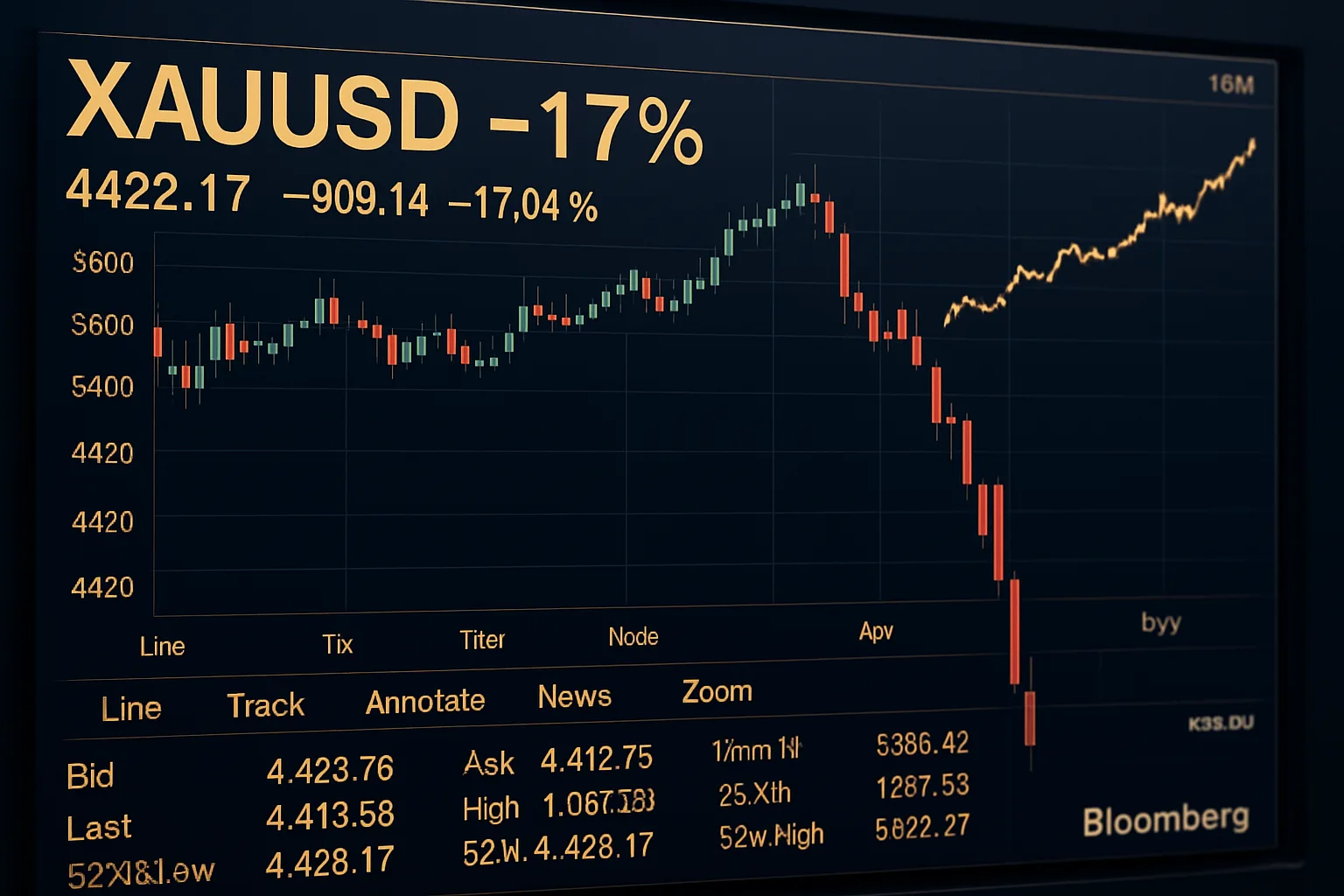
Gold Just Crashed 17%. Best Brokers to Trade XAUUSD in 2026
Gold peaked at $5,600 in February 2026. Today it's trading at $4,422. a 17% collapse in under 6 weeks. Here's what happened, why it happened, and the best brokers to position on XAUUSD right now.
While gold crashes, Exness offers raw XAUUSD spreads from 0.0 pips on Pro accounts. No requotes, instant execution, withdrawals in minutes. Catch the next big move.
Open Exness Account →The Numbers: A 17% Collapse in 6 Weeks
Gold hit an all-time high of $5,600 per troy ounce on February 10, 2026, fueled by central bank buying, geopolitical risk premia, and widespread expectations of Federal Reserve rate cuts. Six weeks later, on March 26, 2026, XAUUSD is trading at $4,422. a drop of $1,178, or 17.1%.
To put that in context: a $50,000 position in gold at the highs has lost approximately $8,550. For leveraged traders running 10:1, that's equivalent to an $85,500 loss on a $50k account. total annihilation for anyone caught on the wrong side without stop-losses.
This is the largest gold drawdown since the 2013 crash when XAUUSD fell 28% over several months. But unlike 2013, this correction has happened at twice the speed.
Why Gold Crashed: 3 Converging Forces
1. The Fed Hawkish Hold
On March 18, the Federal Reserve held rates at 3.50–3.75% for the third consecutive meeting but delivered an unmistakably hawkish message. Chair Powell stated that “progress on inflation has stalled” and signaled that rate cuts in 2026 were “not the base case.” Markets had been pricing in 2–3 cuts by year-end; those expectations are now essentially zero.
Higher-for-longer rates are gold's kryptonite. Gold pays no yield. When you can earn 4.25% risk-free in US Treasuries, the opportunity cost of holding gold becomes prohibitive for institutional investors. The repricing was swift: within 72 hours of the FOMC decision, institutional outflows from gold ETFs exceeded $4.2 billion.
2. USD Surge. DXY Above 107
The US Dollar Index (DXY) has climbed from 102.3 in mid-February to 107.1 as of March 26. a 4.7% move in dollar terms that translates to direct gold price pressure. Gold is priced in USD globally, so a stronger dollar mechanically reduces the price in dollar terms and makes gold more expensive for non-US buyers.
EUR/USD has dropped from 1.0950 to 1.0720 over the same period. USD/JPY climbed from 149.5 to 152.8. The dollar is winning on every front, and gold is losing on every front simultaneously.
3. Oil Shock Paradox
Counterintuitively, the oil price surge that began in late February. triggered by escalating Iran-Israel tensions and Houthi disruptions in the Red Sea. has actually hurt gold rather than helped it. Here's the mechanism: rising oil prices reignited inflation fears, which pushed the Fed into a more hawkish stance, which strengthened the dollar, which crushed gold. The traditional “oil spike = buy gold” trade broke down because the transmission mechanism ran through the Fed rather than through pure safe-haven demand.
WTI crude has climbed from $68 to $84 since February 15. Instead of triggering a gold rally, it triggered a Fed hawkishness rally that ultimately sent gold lower.
Where Is Gold Headed Next?
Key technical levels for XAUUSD right now:
- $4,350: 200-day moving average. critical support, heavily watched by institutions.
- $4,200: Major psychological level and previous resistance turned support from Q4 2025.
- $4,550: Current resistance. the area must be reclaimed for any bullish recovery thesis.
The macro picture remains bearish for gold as long as: (1) US CPI stays above 3%, (2) the Fed maintains its hawkish language, and (3) DXY holds above 105. The next major catalyst will be the April 10 US CPI print. A hot print accelerates the selloff; a miss below 3.0% could trigger a sharp technical bounce.
Medium-term, central bank demand (China, India, Turkey) provides a structural floor. The People's Bank of China added 12 tonnes in February alone. This buying typically intensifies during price weakness, limiting the downside.
Best Brokers to Trade XAUUSD Right Now
In a volatile market, broker quality becomes the difference between profitable trades and unnecessary losses. During the gold crash, spread widening at inferior brokers cost traders 3–5x normal entry costs. Here are the top platforms for XAUUSD trading in 2026:
| Broker | XAUUSD Spread | Leverage | Our Pick |
|---|---|---|---|
| #1 Exness | 0.0 pip | 1:2000 | Best Overall |
| IC Markets | 0.1 pip | 1:500 | ECN, ASIC |
| XM | 0.1 pip | 1:888 | Good for beginners |
| Pepperstone | 0.15 pip | 1:400 | Fast execution |
| AvaTrade | 0.9 pip | 1:400 | Avoid for scalping |
Why Exness Dominates for XAUUSD
Exness's 0.0 pip gold spread on Pro accounts is the tightest in retail forex. On a $100,000 XAUUSD position, that saves you $10+ per trade compared to a broker with 0.1 pip spreads. and $90+ compared to AvaTrade's 0.9 pip spread. Over 20 trades per month, that's over $1,800 in savings.
Also, Exness's “Unlimited Leverage” feature (available on select accounts) allows position sizing flexibility during volatile conditions, and their instant withdrawal system means profits can be accessed the same day. critical during fast-moving markets.
Trading Strategy for the Current Gold Market
Given the current macro environment, here are the setups active traders are watching:
- Short bias on bounces: Any bounce toward $4,550–$4,600 without a change in the macro narrative (Fed tone, DXY trajectory) offers short opportunities. Place stops above $4,650 to avoid the squeeze zone.
- Watch $4,350 for capitulation: If XAUUSD breaks below the 200-day moving average at $4,350, a fast drop to $4,200 is possible. This is also where institutional buyers typically step in.
- Macro hedge long for tail risk: Keep a small long position as a hedge against sudden geopolitical escalation or a surprising dovish Fed pivot. Gold can reverse 3–5% in hours on geopolitical news.
Best Brokers for Gold (XAU/USD)
Low spreads on XAU/USD, tested live.
Trade XAUUSD at 0.0 Pip Spreads
Exness is the #1 broker for gold trading in 2026. Raw spreads, instant withdrawals, leverage up to 1:2000, and the deepest XAUUSD liquidity in retail forex.
Start Trading on Exness →