
How to Trade Gold During an Oil Price Shock
Oil hit $84 on Iran/Middle East tensions. Normally, gold rallies. This time, it's crashing. Understanding why. and how to trade it. could be the edge that defines your 2026.
Exness and FP Markets both offer XAUUSD and crude oil CFDs with tight spreads. Position on the oil-gold divergence with top-tier execution.
The Oil-Gold Paradox of 2026
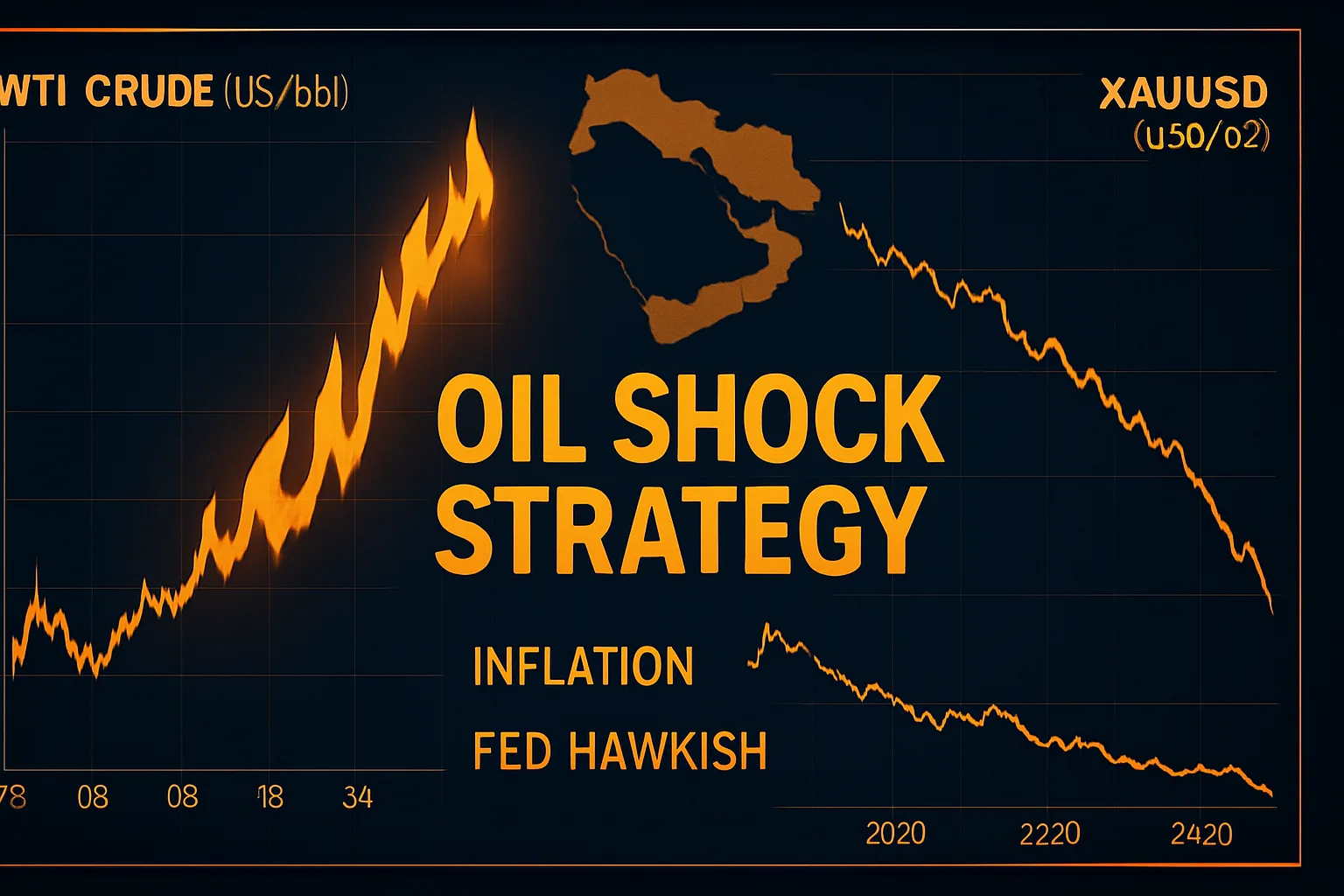
Conventional wisdom says: oil price spike → inflation fears → buy gold as inflation hedge. It worked in 1973, 1979, 1990, 2008, and 2022. This year, it isn't working. WTI crude has climbed from $68 to $84 since February 15, 2026. a 23.5% surge. Over the same period, gold has dropped from $5,000 to $4,422. an 11.6% decline.
Understanding why this is happening is essential before you position on either asset. The answer is in the transmission mechanism: in 2026, rising oil prices are hawkish for the Fed, not bullish for gold.
Why the Transmission Mechanism Has Broken
Here is the causal chain that's playing out right now:
- Iran-Israel tensions + Houthi Red Sea disruptions push WTI crude from $68 to $84 in 6 weeks (Feb–March 2026).
- Higher oil → higher energy inflation. February CPI printed at 3.4%, above the 3.1% consensus. Energy component contributed 0.4 percentage points.
- Fed interprets oil-driven CPI as sticky inflation. Powell says “progress has stalled.” Rate cut timeline gets pushed back indefinitely.
- No Fed cuts = stronger USD. DXY surges from 102 to 107, making gold more expensive for non-USD buyers globally.
- USD strength overrides gold's inflation-hedge narrative. Gold falls 11.6% while oil rises 23.5%.
The key insight: when the Fed is not pinned at zero (as it was in 2020–2022), oil shocks don't automatically benefit gold. They can actually hurt gold by keeping rates higher for longer.
When Oil Shocks ARE Bullish for Gold
Not all oil shocks are created equal. Gold typically rallies during oil shocks under these conditions:
- Zero-rate environment: When rates are already at zero, the Fed can't hike to fight oil-driven inflation. Gold benefits from real negative rates.
- War premium dominant: When geopolitical risk is the primary driver (not just supply disruption), gold's safe-haven bid outweighs the currency effect. Example: gold rallied on Russia-Ukraine in 2022 even as USD strengthened.
- USD supply shock: Oil shocks accompanied by USD weakness (petrodollar recycling into alternative assets) benefit gold. This happened in 2007–2008.
In 2026, none of these conditions apply. Rates are at 3.5%, the Fed is hawkish, and geopolitical risk is priced as a supply-side inflation risk rather than a pure war premium. Gold is trapped.
The Middle East Risk Premium: What Could Change
The Iran-Israel situation remains the wild card. Current oil market pricing implies a “moderate tension” scenario where disruptions are real but contained. The risk scenarios that could change the gold narrative rapidly:
- Strait of Hormuz closure or credible threat: 20% of global oil supply transits this waterway. A real closure scenario would spike Brent to $120+ and trigger panic buying of gold regardless of the Fed.
- Direct Iran-US military confrontation: This is pure safe-haven territory. Gold would rally $200–$400 in hours if this materialized.
- Saudi Arabia draws into conflict: OPEC production risk would fundamentally reorder commodity market priorities.
For now, markets are treating the Middle East situation as an inflation risk, not an existential geopolitical risk. That could change overnight.
Practical Trading Strategies
Strategy 1: The Divergence Short
Sell gold (XAUUSD), buy oil (WTI/USOIL). The divergence between these two assets is at an extreme not seen since 2015. As long as the Fed stays hawkish, this divergence tends to persist. Entry: short XAUUSD at $4,500+, long USOIL at $82–$84. Stop-loss on the gold short above $4,650; stop on oil below $79.
Strategy 2: Geopolitical Hedge Long
Maintain a small XAUUSD long position (1–2% of account) as a tail-risk hedge against sudden Middle East escalation. This is not a directional trade. it's insurance. The cost of carrying this position (negative swap) is your insurance premium. Set a wide stop at $4,150 and a profit target at $4,800+.
Strategy 3: News-Driven Momentum
Monitor geopolitical headlines in real time. When major escalation news breaks, gold can move $50–$100 within minutes. A news-based momentum strategy requires: (a) a broker with instant execution and no requotes, (b) tight spreads (widening during news is the enemy), and (c) pre-set orders ready to fire. Exness's zero-spread accounts are specifically designed for this scenario.
Strategy 4: Wait for Structural Resolution
The highest-conviction gold trade comes after the macro catalyst resolves. If oil falls back below $75 on a de-escalation of Iran tensions, the inflation narrative weakens, the Fed turns slightly more dovish, and gold could rally sharply. Patience here may be the best strategy. position sizing down during uncertainty, ready to size up when the macro backdrop clarifies.
Best Brokers for Gold & Oil Trading
The oil-gold divergence trade requires a broker offering both commodities with tight, stable spreads. Two standouts:
| Broker | XAUUSD Spread | WTI Spread | Strength |
|---|---|---|---|
| Exness | 0.0 pip | 2–3 pts | Best gold spreads, instant withdrawal |
| FP Markets | 0.2 pip | 1–2 pts | Excellent for oil CFDs, tight energy spreads |
Best Brokers for Gold (XAU/USD)
Low spreads on XAU/USD, tested live.