
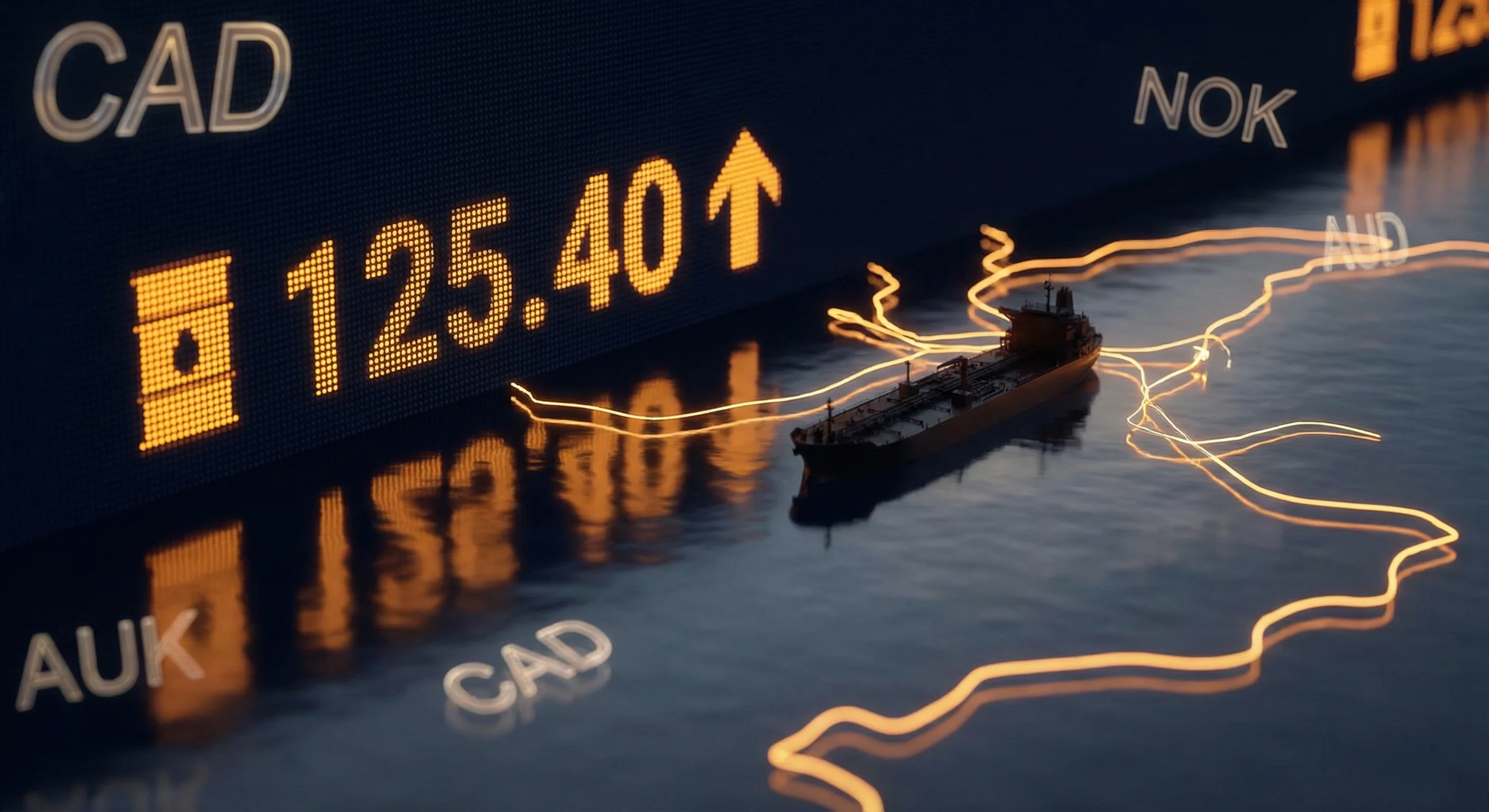
Hormuz Ceasefire & Forex: How the $125 Oil Shock Is Rewiring Commodity Currencies
Brent crude peaked at $126 per barrel in late March, the highest price in four years, after roughly 11 million barrels per day of Middle East crude effectively disappeared from the market. Then on April 7, a two-week US-Iran ceasefire was announced. Oil dropped fast. The commodity currencies. Canadian Dollar, Norwegian Krone, Australian Dollar, should have followed. They didn't. Not cleanly. Not in the way the textbooks say they're supposed to.
What's happening right now in the commodity currency space is one of the more interesting fractures in recent forex history. The old correlations haven't disappeared, but they've been overlaid with something messier, and trading the old version without adjusting for the new reality is expensive.
The Ceasefire Trade: What Oil Markets Actually Did
The ceasefire announced April 7–8 knocked Brent back from near $125 toward $112. That's a significant move, roughly a 10% drop in 48 hours. But it's worth noting what the market is actually pricing: not peace, but a pause. Iran has asserted a "selective control and toll-collection regime" on Strait traffic. That's not a reopening. It's a negotiating position wrapped in maritime law.
Markets processed this correctly, which is why oil fell but didn't collapse. The $15–20 geopolitical risk premium remains baked in. Any trader pricing a full normalization of Strait traffic in the near term is making a speculative bet, not reading the fundamentals.
The key number to watch: Dallas Fed research suggests that a full sustained closure for a quarter would reduce global real GDP by an annualized 2.9 percentage points. That threat hasn't gone away, and currency markets know it.
CAD: The Oil Currency That Didn't Rally
Here's the puzzle. Canada is one of the world's largest oil exporters. When Brent goes to $125, Canadian export revenues should surge, trade balances should improve, and the Loonie should strengthen. That's the theory. The practice, in April 2026, has been considerably murkier.
The CAD declined against the USD even as crude spiked. FX Street reported it directly: Canadian Dollar declines despite rising oil prices, April 7. The reason is straightforward once you accept that "risk-off" sentiment is dominating "commodity fundamentals" right now. When global markets go into fear mode. and $125 Brent combined with Middle East conflict qualifies, money flows into USD, period. The CAD's oil benefit gets swamped by the dollar safe-haven bid.
There's a secondary factor too. Canadian oil trades at a persistent discount to Brent (the WCS-WTI spread). And the disruption is concentrated in Middle Eastern grades, not North American supply. Canadian producers benefit from higher prices, but not as directly as the headline Brent number implies.
NOK: The Cleaner Oil Play
The Norwegian Krone has been a more faithful proxy for oil moves through this crisis than CAD, but even NOK is running into its own complications. Norway is Western Europe's largest oil exporter, and Norges Bank policy has been supportive. The NOK correlation with Brent held more cleanly through the initial spike.
The catch is that NOK/USD and EUR/NOK tend to amplify in both directions. When oil fell 10% on the ceasefire announcement, NOK gave back gains quickly. The currency is highly liquid and institutional players trade it as a direct oil proxy, which means volatility runs both ways, especially on headline-driven moves like a ceasefire announcement at 2am European time.
For traders with a clear oil directional view, EUR/NOK short (NOK long) remains a cleaner expression than CAD/USD. The EUR is itself under pressure from Europe's energy import bill, paying near $150/barrel for certain crude grades. making the denominator weaker even as NOK strengthens. That amplifier matters.
AUD: The Commodity Currency That Changed Character
Australia is a net energy importer for oil, which historically made AUD's commodity sensitivity more about metals, iron ore, copper, than crude. In a different crisis, you'd expect AUD to get caught in the crossfire, hurt by higher import costs rather than helped by oil revenues. And yet AUD rallied sharply during the initial crisis spike. Then reversed.
OANDA analysis from April 6 put the numbers starkly: AUD's 20-day rolling correlation with global equities surged to 0.56 from 0.12 in mid-March. The traditional commodity correlation effectively got parked. AUD is now trading almost entirely off risk appetite, when global stocks rally, AUD rallies; when they drop, AUD drops. Oil price direction barely registers.
This is actually useful information. It means AUD is a cleaner risk-on/risk-off instrument right now than it usually is. If the ceasefire holds and equity markets recover, AUD/USD has upside. If it breaks and we get another $125+ crude spike with equities selling off, AUD falls hard regardless of commodity logic.
What Traders Are Saying
The dominant view on trading desks right now is that the ceasefire is a tactical breather, not a structural resolution, and position-sizing is being managed accordingly. Most active traders are avoiding large directional CAD longs because the USD safe-haven override is still live. The more popular expression has been EUR/NOK shorts for the oil-long view, with tighter stops than usual given the ceasefire volatility. On AUD, the conversation has shifted almost entirely to macro risk sentiment: desks treating it like a high-beta equity proxy rather than a commodity play. The collective trade isn't "buy commodity currencies because oil is high". it's "navigate the fracture between what oil is doing and what the currencies should theoretically do, and exploit the gap."
The Playbook: Three Scenarios from Here
Ceasefire holds, Strait partially reopens: Oil drifts back toward $95–105, USD strength fades, CAD and NOK recover against the dollar and euro respectively. AUD follows equities higher. This is the "normalization trade", but it requires trusting Iran's compliance with terms that remain publicly vague. Risk: the geopolitical premium un-winds faster than expected if tanker traffic resumes quickly.
Ceasefire breaks down within weeks: Oil spikes back above $120. USD restrengthens on risk-off. CAD falls despite Canadian oil benefit. NOK volatile but potentially outperforms CAD given cleaner oil exposure. AUD sells off with equities. This scenario punishes anyone who went fully risk-on after the April 7 announcement.
Prolonged standoff, Iran's "toll regime" persists: The most economically damaging scenario. Stagflation fears dominate, high energy prices, slowing growth, rate cut timelines pushed further out. In this environment, traditional commodity currency logic breaks almost completely. USD and CHF outperform. CAD, NOK, and AUD all underperform relative to historical oil-positive scenarios. This is the environment where the correlation data OANDA cited, AUD moving with equities, not oil. becomes the permanent new baseline.
Risk Management in a Broken Correlation Regime
When correlations fracture, position sizing matters more than directional view. The standard recommendation, reduce size, widen stops, be selective, sounds like a cliché until you're watching CAD drop 80 pips while crude is up $4. That's not noise. That's the market telling you that the relationship you're trading has temporarily broken.
Use rolling 20-day correlation metrics on your pairs. OANDA's shift data for AUD is a real-time example of why this matters. If your model assumes a 0.7 correlation between CAD and crude and that correlation is currently 0.2, your risk estimates are wrong by a factor of three. That's a lot.
One practical adjustment: key geopolitical dates, Strait transit confirmation reports, UN Security Council votes (a draft resolution was tabled April 8), Iran's own statements, should be treated as event risk, not background noise. That means sizing down before those windows, not after.
The Bottom Line
The Hormuz crisis has done something unusual to commodity currencies: it's forced a separation between the "commodity" part and the "currency" part of the thesis. The old linkage. oil up, CAD up, NOK up, still exists but it's been subordinated to a higher-order regime of dollar safe-haven flows and global risk sentiment. Until the Strait genuinely reopens and the geopolitical risk premium bleeds out of crude, you're not really trading commodity fundamentals. You're trading fear and the ceasefire news cycle.
That's tradeable. But it requires a different framework than the one most commodity currency traders are running. The traders making money right now are the ones who updated their model when the data changed, not the ones still waiting for correlations to snap back.
Trade commodity currency pairs
Execute on this analysis with tight spreads
Exness offers CAD/USD, EUR/NOK, and AUD/USD with institutional-grade spreads and execution, critical when correlation regimes are unstable and you need precise entries.
Open Account at Exness →Related Analysis
James Morgan
Senior Forex Analyst, Forex Mobile
Covers macro, commodities, and geopolitical risk in currency markets.