
How to Read Forex Charts: Complete Guide for 2026
Forex charts are the primary language of trading. If you can't read them, you're flying blind. This guide covers everything, from candlesticks to chart patterns, with clear examples so you can start reading price action today.
Exness offers a free demo account with full MT4/MT5 charting. Practice reading charts on live market data with zero risk.
Open Free Demo Account →- 1The 3 types of forex charts
- 2How to read candlestick charts
- 3Support and resistance levels
- 4Trend lines and channels
- 5Timeframes: which to use and when
- 6The most important chart patterns
- 7How to combine charts with indicators
The 3 Types of Forex Charts
Every forex platform offers multiple chart types. Understanding the differences helps you pick the right one for your trading style.
Connects closing prices. Shows trend direction cleanly but loses open/high/low data. Good for big-picture trend analysis.
Best for: Big picture overviewShows Open, High, Low, and Close for each period. Compact but harder to read at a glance. Common on institutional platforms.
Best for: Precise OHLC dataJapanese candlesticks show OHLC visually with a body and wicks. The most popular chart type. Better pattern recognition than bars.
Best for: Most traders (use this)For the rest of this guide, we'll focus on candlestick charts, the industry standard used by retail and professional traders alike.
How to Read Candlestick Charts
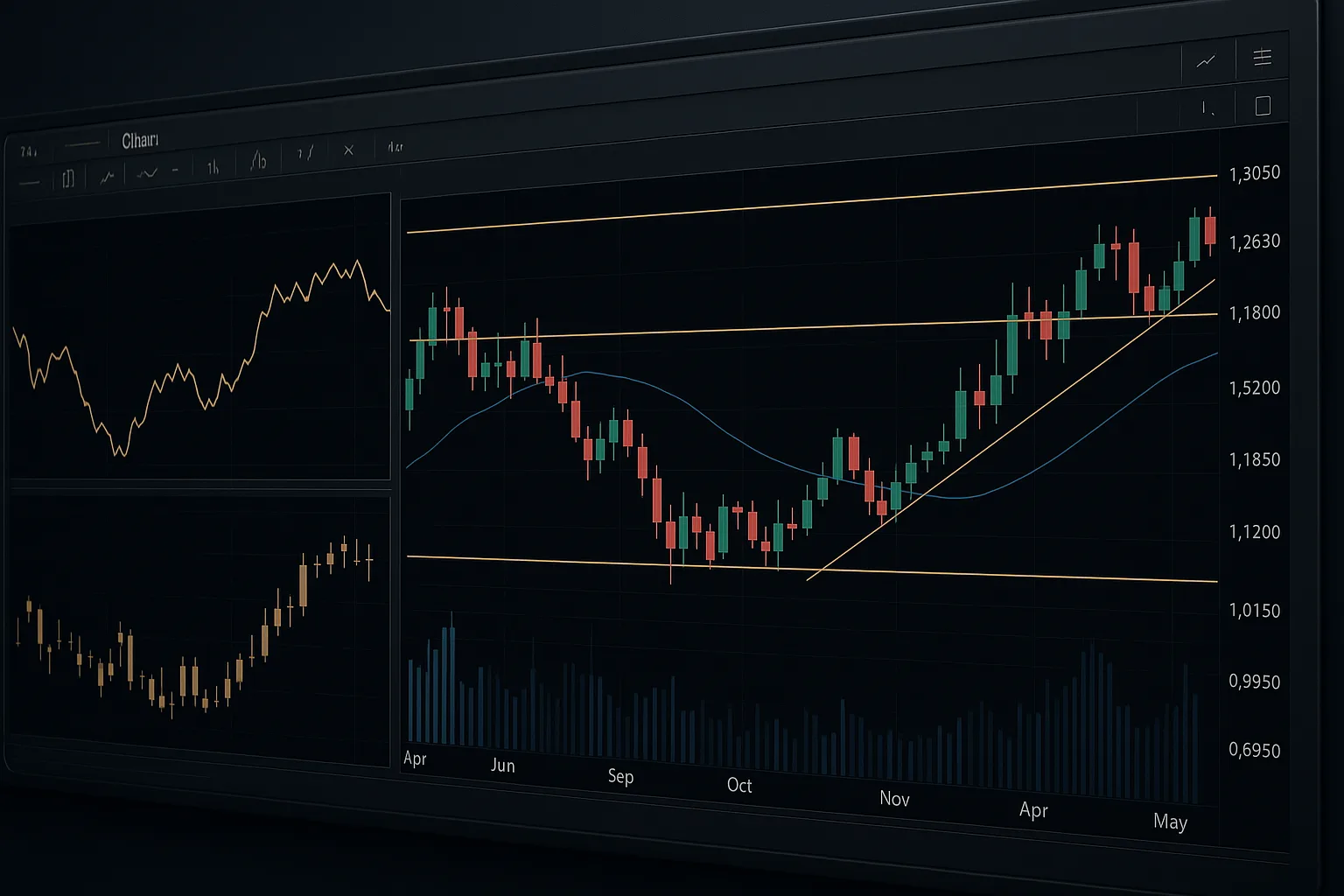
Each candlestick represents one period of price action. it could be 1 minute, 1 hour, 1 day, or any other timeframe. Every candle tells you four things: where price opened, where it closed, and the highest and lowest points reached during that period.
Key Candlestick Patterns to Know
Individual candle shapes carry meaning. These patterns signal potential reversals or continuations:
| Pattern | Signal |
|---|---|
| Doji | ⚠️ Indecision |
| Hammer | Bullish Reversal |
| Shooting Star | Bearish Reversal |
| Engulfing (Bullish) | Strong Bullish |
| Engulfing (Bearish) | Strong Bearish |
| Pin Bar | ↩️ Rejection |
| Inside Bar | ⏸️ Consolidation |
Support and Resistance: The Foundation of Chart Analysis
Support and resistance are price levels where buying or selling pressure has historically been strong enough to stop or reverse price movement. They're the single most important concept in technical analysis.
Support is a price level where demand is strong enough to prevent further decline, a floor under price. Resistance is a price level where supply is strong enough to cap further rises, a ceiling above price.
Trend Lines and Channels
A trend line connects a series of higher lows (in an uptrend) or lower highs (in a downtrend), creating a dynamic support or resistance line that moves with price.
Drawing an Uptrend Line
Connect at least two swing lows (the low points between peaks) with a straight line going upward. A valid uptrend line has a positive slope. Each time price pulls back and bounces off this line, it confirms the trend. A break below the trend line signals a potential trend change.
Drawing a Downtrend Line
Connect at least two swing highs going downward. Price bouncing off this line confirms the downtrend. A break above signals potential reversal. This has been highly relevant in March 2026 as gold (XAUUSD) has been in a sharp downtrend from all-time highs above $5,600, traders using trend lines caught the move early.
Price Channels
A channel is two parallel trend lines, one connecting highs, one connecting lows. Price oscillates between the channel boundaries. Traders buy at the lower channel boundary (support) and sell at the upper boundary (resistance), or trade breakouts when price exits the channel.
Timeframes: Which to Use and When
Every chart you see is set to a specific timeframe, how much price action each candle represents. Choosing the right timeframe depends on your trading style.
| Timeframe | Best For |
|---|---|
| M1 (1-minute) | Scalpers |
| M5 (5-minute) | Scalpers / Day traders |
| M15 (15-minute) | Day traders |
| H1 (1-hour) | Intraday / Swing traders |
| H4 (4-hour) | Swing traders |
| D1 (Daily) | Swing / Position traders |
| W1 (Weekly) | Position traders / Investors |
A common approach is multi-timeframe analysis: use the daily chart to identify the trend and key levels, then drop to the H4 or H1 to find entry timing, and use M15 or M5 for precise entries. This gives you context from higher timeframes with precision from lower ones.
The Most Important Chart Patterns
Chart patterns are formations created by price action that tend to precede predictable moves. They fall into two categories: continuation patterns (price continues in the same direction after a pause) and reversal patterns (price reverses direction).
Reversal Patterns
Three peaks: left shoulder, higher head, right shoulder. Neckline break confirms the pattern. One of the most reliable reversal signals in technical analysis.
Three troughs: left shoulder, lower head, right shoulder. Neckline break upward confirms. Strong bullish reversal, especially after extended downtrends.
Price hits a resistance level twice and fails both times. M-shaped formation. Sell signal on the break of the valley between the two peaks.
Price hits support twice and bounces. W-shaped formation. Buy signal on the break above the peak between the two lows.
Continuation Patterns
- Flag and Pennant: A sharp move followed by a brief consolidation (the flag or pennant), then a continuation in the original direction. Common in strong trending markets.
- Wedge: Converging trend lines, a rising wedge typically breaks downward; a falling wedge breaks upward. Can be both reversal and continuation.
- Triangle (Ascending/Descending/Symmetrical): Price coils between converging support and resistance. Breakout direction determines the trade. Ascending triangles favor bullish breaks; descending triangles favor bearish breaks.
- Rectangle: Price bounces horizontally between two parallel levels. Trade the breakout from either side, or fade the boundaries within the range.
Combining Charts with Indicators
Raw price action (candlesticks, patterns, S/R) is powerful on its own. but most traders add a small set of indicators to filter signals and measure momentum.
The key is to not over-clutter your charts. Three indicators of different types (trend, momentum, volume) is enough. Adding more creates noise and conflicting signals.
20 EMA, 50 EMA, 200 EMA. Price above = uptrend. Price below = downtrend. EMA crossovers generate signals.
Oscillates 0–100. Above 70 = overbought. Below 30 = oversold. Use to time entries within a trend.
Three bands around price. Squeeze = low volatility (breakout coming). Price touching outer band = extended move.
How to Start Reading Charts in Practice
Reading charts is a skill that improves with repetition. Here's a systematic approach for beginners:
- Start with the daily chart, identify the dominant trend (up, down, or ranging).
- Mark key S/R levels, find the most obvious price zones where the market has reacted multiple times.
- Drop to H4, see how current price relates to your daily levels. Is price at support in an uptrend? That's a buy candidate.
- Look for a candlestick signal, a hammer, pin bar, or engulfing candle at your level adds confirmation.
- Check your indicator. RSI oversold at support in an uptrend? High-probability setup.
- Define your trade, entry, stop loss (below the support level), and take profit (next resistance level).
The best place to practice this is on a demo account with live market data. Exness provides a free demo account with full MT4 and MT5 access — see our best MT5 brokers for more options. You can practice reading real EURUSD, GBPUSD, and XAUUSD charts without risking real money. See our other guides or the methodology page for how we evaluate brokers.
Recommended Brokers
All brokers independently reviewed and tested by our team.
Ready to Practice on Real Charts?
Open a free Exness demo account and apply everything in this guide to live EURUSD, XAUUSD, and 200+ instruments. No deposit required.
Trusted by 800,000+ traders worldwide. Regulated by FCA, CySEC, FSCA.
Open Free Demo Account →- ✓Use candlestick charts, they show the most price action information at a glance.
- ✓Support and resistance levels are the foundation of all chart analysis.
- ✓Trend lines help you trade with momentum rather than against it.
- ✓Match your timeframe to your trading style: scalper → M1/M5, swing trader → H4/D1.
- ✓Keep indicators simple: one trend, one momentum, one volatility indicator is enough.
- ✓Multi-timeframe analysis gives you direction from higher timeframes and entry precision from lower ones.